
SMBA: Briefly, what is the Dunning-Kruehr effect?
lmstudio-community/gemma-4-31b-it-qat:
In short: The Dunning-Kruger effect is a cognitive distortion in which people with low competence in a given area overestimate their abilities.
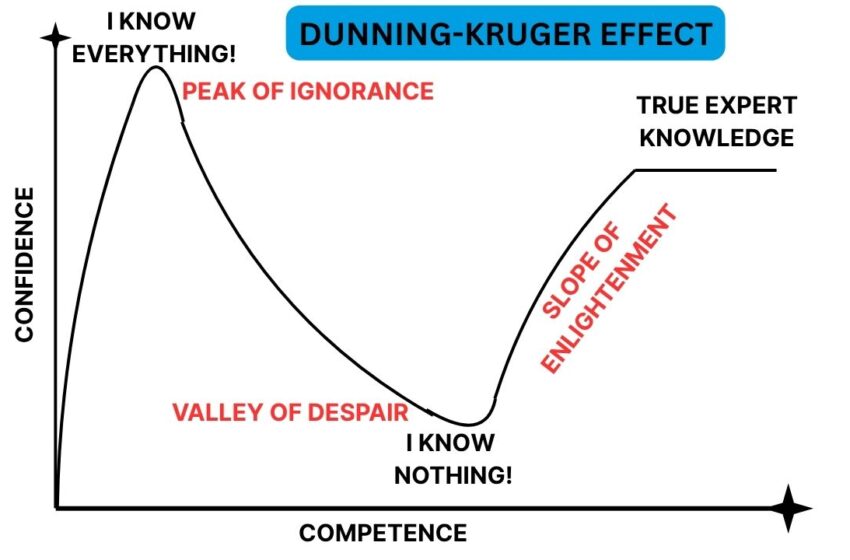
In simple words: Man knows too little to realize how much he does not really know.
Why is it happening?
Because in order to understand that you are weak in something, you need a certain level of knowledge on this topic. Since the beginner does not have this knowledge, he thinks that everything is easy and that he already masters it.
In short: Low skills – High self-confidence.
SMBA: How is the Dunning-Kruger effect expressed in the field of martial arts?
The Dunning-Kruger effect is a cognitive distortion in which people with low competence in a given area overestimate their abilities because they do not possess enough knowledge to realize how incompetent they really are.
In martial arts, this effect is extremely palpable and often follows a predictable cycle. Here is how it manifests itself in the different stages of a fighter’s development:
- “The Pinnacle of Stupidity” (The Beginner with Excessive Self-Confidence)
This is the first phase in which the student learns several basic techniques (for example, the straight shot, several grips or a slow-executed swing).
- Symptoms: The beginner thinks that he has already “understood the principle” of fighting or punches. He may begin to analyze fights on television or explain to others how they should fight.
- Why it happens: Since he has not yet experienced real pressure (sparring with an experienced fighter), he does not know what “distance”, “timing” or “reaction” means. He sees the technique as a static movement, not as a dynamic process.
- Danger: At this stage, people are most likely to challenge themselves to battles outside the gym, believing that their “tricks” will work against an experienced opponent.
- “The Valley of Despair” (The Clash with Reality)
This stage occurs when a beginner first enters into serious sparring with someone who is significantly more experienced (for example, a “black belt” or a professional).
- Symptoms: Shocking realization of one’s own helplessness. The fighter discovers that he cannot hit the opponent, that he suffocates in seconds, or that he falls on his back without even realizing what happened.
- Psychological effect: Self-confidence drops sharply. Thoughts appear, such as: *”I will never learn it”, “I am not for this”, “Everything I thought I knew was wrong”.*
- Meaning: This is the most important point in learning. Here the person ceases to be a victim of the Dunning-Kruger effect and the real learning begins, because he is already aware of the scale of what he does not know.
- “The Path to Enlightenment” (Gradual Building of Real Skills)
Having accepted his incompetence, the student begins to work systematically.
- Symptoms: Focus on the basics. He no longer tries to do “spinning kicks with his foot”, but learns how to properly stand in a posture and how to breathe.
- Change in mindset: Instead of “I’m the best,” he starts thinking, “I want to understand why this shot doesn’t work in this situation.”
- The Plateau of Expertise (The Humility of the Master)
When a fighter reaches a high level, a paradox happens – he becomes extremely skillful, but he is often the most humble person in the gym.
- Symptoms: The expert knows that martial arts are endless. He realizes that there is always someone faster, stronger, or more technical than him.
- The difference: While the beginner (in the Dunning-Kruger effect) thinks he knows everything, the expert knows exactly where the limits of his knowledge are and is constantly looking for a way to expand it.
Summary in the context of the House:
| Stage | Perception of your skills | Real-world skills | Characteristic behavior |
| Beginner (Dunning-Kruger) | “I’m a machine, I can beat anyone!” | A lot of nisca | Ignores defense, quick self-confidence. |
| Intermediate | “I can’t do anything, everything is too hard.” | Growing | He analyzes his mistakes, trains hard. |
| Expert | “I know a lot, but there’s still a lot to learn.” | High | Humility, attention to detail and strategy. |
Conclusion: In martial arts, the Dunning-Kruger effect is cured only by sparring. Sparring is a “reality checking tool” that quickly takes a person off the “peak of stupidity” and puts him on the path to true mastery.
SMBA: Purely philosophical, how does the effect contradict martial arts?
lmstudio-community/gemma-4-31b-it-qat:
Purely philosophically, the contradiction between the Dunning-Kruger effect and the essence of martial arts is fundamental. It is not just a discrepancy in the “assessment of skills”, but a clash between Illusion and Reality, between Ego and Truth.
Here are a few philosophical levels at which this effect contradicts the spirit of martial arts:
- The conflict between “The Way” (Do) and “The Goal”
Most traditional martial arts are not just sports, but “Path” (*Do* in Japanese – like in Judo, Aikido, Kendo). The philosophy of the Path assumes that development is an infinite process.
- The Dunning-Kruger effect creates the illusion of “arriving”. When a person believes that he already has mastery of art (when in fact he is at the beginning), he stops looking.
- The contradiction: The moment the practitioner thinks he has “arrived”, he de facto leaves the Path. Philosophically speaking, the self-confidence of the beginner is the death of the teaching.
- The paradox of the “Empty Judgment” (Zen philosophy)
In Zen Buddhism and many Eastern martial arts, there is the concept of *Shoshin* (Mind of a Beginner). It says that in order to learn something new, you must first empty your vessel of prejudice and false knowledge.
- The Dunning-Kruger effect is a “complete vessel” filled with air (illusions). The person at this stage cannot accept new information because his ego tells him that he already has it.
- The contradiction: The Dunning-Kruger effect is a cognitive barrier that makes philosophical “emptying the court” impossible. It replaces humility (a tool for growth) with pride (an obstacle to growth).
- The Clash Between Subjective Truth and Objective Reality
Martial arts are one of the most brutally honest disciplines in the world. Unlike theory or politics, where you can convince others of your rightness through rhetoric, in martial arts the “truth” is physical and objective.
- The Dunning-Kruger effect is the triumph of subjective perception over objective fact.
- The contradiction: Martial arts are a form of “ontological correction”; they exist to subvert false ideas about themselves. When a person with the Dunning-Kruger effect is confronted by a real expert in sparring, a “philosophical shock” happens—reality shatters the illusion.
- The Ethics of Responsibility and Humility
The warrior’s philosophy (e.g., *Bushido*) places great emphasis on self-control and awareness of one’s own limitations. Knowing exactly where your abilities end is a matter of survival and ethics.
- The Dunning-Kruger effect leads to recklessness, which is the opposite of courage. Courage requires awareness of danger; recklessness stems from ignorance of it.
- The contradiction: The effect replaces Wisdom (which knows what it does not know) with Ignorance (ignorance). In martial arts, this is a moral failure, as it entails an undue risk to oneself and others.
Summary
If we have to summarize it in a philosophical thesis:
The Dunning-Kruger effect is a state of “closure” (the ego is confined to its own small room), while martial arts are a process of “opening” (expanding consciousness by acknowledging one’s own worthlessness in the face of mastery).
Therefore, the most valuable moment in martial arts training is not when you learn a new technique, but when you fall into the “Valley of Despair” – because this is the moment when you philosophically stop being a victim of Dunning-Kruger and begin your true development.


